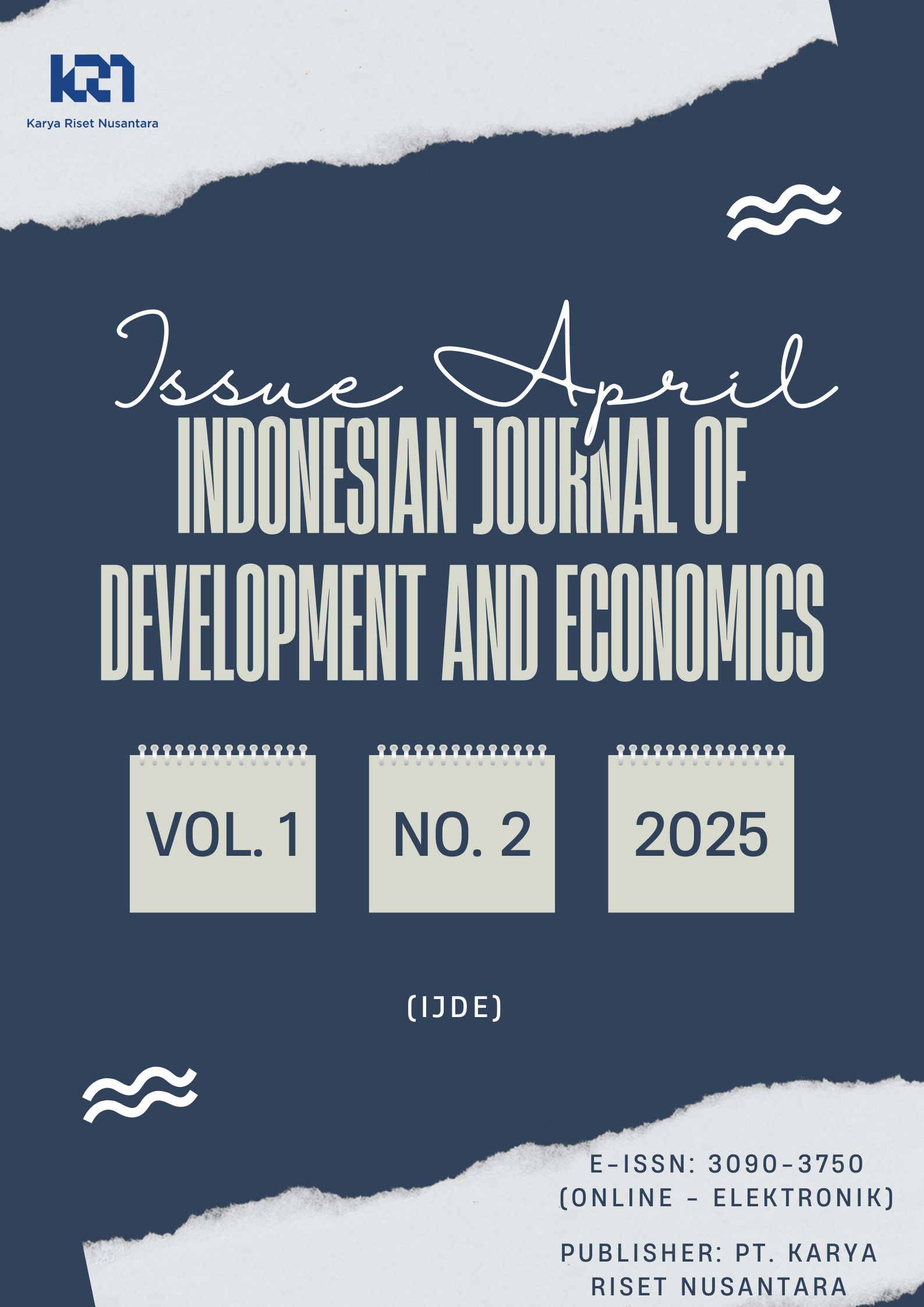
Analysis of the Impact of Deficit, Inflation, and Interest Rates on Economic Growth in Indonesia (1990–2023)
DOI:
https://doi.org/10.65886/ijde.v1i2.39Keywords:
Deficit, Inflation, Interest Rate, Economic Growth, COVID-19Abstract
This study discusses the Effects of Deficits, Inflation, and Interest Rates on economic growth, especially after the COVID-19 pandemic. This topic is interesting to study because it concerns the effectiveness of macroeconomic policy management in maintaining long-term growth. This study examines how the budget deficit, inflation, and interest rates affect Indonesia's long-term economic growth, particularly by comparing conditions before and after the COVID-19 pandemic. This study is new in terms of scope and depth of analysis. Few previous studies have simultaneously examined these three variables over a long period (1990–2023), especially given the differences in conditions before and after the pandemic. The method used is a quantitative approach, with an OLS regression model from 1990 to 2023, and testing classical assumptions to ensure the model's validity. Secondary data are drawn from official publications of the World Bank and the Ministry of Finance of the Republic of Indonesia. The results of the study show that the budget deficit variable has a significant positive effect, while inflation and interest rates simultaneously have a significant adverse impact on economic growth. With R-squared values of 0.8420 and 0.8202, the three variables explain economic growth firmly, though with varying influence across the periods before and after the pandemic. This finding underscores the need for synchronization between fiscal and monetary policies to maintain long-term economic stability and growth.
Downloads
References
AKINTUNDE, A. J., & ARUMONA, J. (2020). Effect of Budget Deficit and Foreign Direct Investment on Economic Growth in Nigeria. 11(2013), 87–97. https://doi.org/10.9790/5933-1103031623
Alfatar, T., & Soebagiyo, D. (2023). Analysis of the Influence of Macroeconomic Variables on Economic Growth During the Period 2001-2022. Primanomics: Journal of Economics & Business, 21(2), 149–160. https://doi.org/10.31253/pe.v21i2.1883
Algifari, S., H., & Purnamawati, A. (2023). Evaluation of Interest Rate Policies in Creating Financial Stability and Price Stability in Indonesia. Business Review, 24(1), 1. https://doi.org/10.35917/tb.v24i1.322
Ananzeh, I. (2016). Analyzing the
Dynamic Relationship between Budget Deficit, Inflation, and Interest Rate (A Case from Jordan). European Journal of Business and Management, 8(29), 121–130.
Bank Indonesia. (2024). Interest Rate. Bank Indonesia. https://www.bi.go.id/id/fungsi-utama/moneter/bi-rate/default.aspx
Bilan, I. (2007). Inflationary effects of budget deficit financing in contemporary economies, Angela Boariu * Irina Bilan *. January 2007.
Caporale, G. M., Pittis, N., & Prodromidis, K. (2013). Budget Deficits and Interest Rates: a Cointegration and Causality Analysis. Revista Brasileira de Economia de Empresas, 4(1), 43–61.
Cheasty, A. (nd). Financing Fiscal Deficits © International Monetary Fund. Not for Redistribution © International Monetary Fund. Not for Redistribution.
Devereux, M. B. (2010). Fiscal Deficits, Debt, and Monetary Policy in a Liquidity Trap. Federal Reserve Bank of Dallas, Globalization and Monetary Policy Institute Working Papers, 2(44), 2–30. https://doi.org/10.24149/gwp44
Diana Wulansari Suci, AR (2024). The Impact of Fiscal and Monetary Policies on Indonesia's Economic Performance: A Critical Analysis. Indonesian Journal of Regional Economics, 66.
Dwinada, AS, & Berly, M. (2015). The Effect of Fiscal Deficit on Economic Growth in Indonesia in the Period 1990-2012. Indonesian Journal of Economics and Development, 15(2), 144–157. https://doi.org/10.21002/jepi.v15i2.03
Elfina, O., Resna, N., & Dina, VP (2023). The Effect of Inflation and Interest Rates on Economic Growth in North Sumatra Province in 2013 – 2021. Accusi Scientific Journal, 5(1), 14–24. https://doi.org/10.36985/a86hy427
Elisabeth, P., & Sugiyanto, F. (2021). Analysis of the Effect of Budget Deficit, Central Government Spending, and Government Debt on Economic Growth in Indonesia 1990-2019. Diponegoro Journal of Economics, 10(3), 184–207.
Fadia Haya, A., Indah Nikensari, S., Nurjanah, S., Negeri Jakarta, U., & Correspondent Author, I. (2022). Analysis of the Influence of Consumption, Investment, and Export on Indonesia'S Economic Growth in the Pandemic Year 2020-2021. International Journal of Multidisciplinary Research and Literature IJOMRAL, 1(5), 481–600. https://doi.org/10.53067/ijomral.v1i5.55
Fakher, H. A. (2016). The empirical relationship between fiscal deficits and inflation (Case study: Selected Asian economies). Iranian Economic Review, 20(4), 551–579.
Fildzah, I., & Munawar. (2017). Analysis of the Impact of Budget Deficit on Inflation, Money Supply, and Interest Rates in Indonesia. Student Scientific Journal of FEB Brawijaya University, 5(2).
Gusti, A. (2024). The Effect of Interest Rates on Inflation in Indonesia. Journal of Social Science Entrepreneurship and Culture, 02(2), 39. https://doi.org/10.47313/oikonomia.v18i1.1546
Hazmi, Y. (2018). Analysis of Credit, GDP, Inflation, and Interest Rates on Economic Growth. Journal of Economics and Business, 20(2), 79–83. http://e-jurnal.pnl.ac.id/index.php/ekonis/article/view/595
Husna, K., & Daryono, S. (2023). Analysis Of The Effect Of Monetary Policy On Indonesia's Budget Deficit 2000-2022 Analysis. Management Studies and Entrepreneurship Journal, 4(5), 5635–5641. https://ojs.unm.ac.id/economix/article/download/8497/4933
Husriah. (2019). The Effect of State Budget Deficit on Economic Growth in Indonesia. Economix Journal, 7, 17–24.
Istiqomah, N., & Mafruhah, I. (2022a). Economics Development Analysis Journal The Effect of Budget Deficit in Indonesia: A Comparative Study Article Information. Economics Development Analysis Journal, 1, 110–119. http://journal.unnes.ac.id/sju/index.php/edaj
Istiqomah, N., & Mafruhah, I. (2022b). Impact of Budget Deficit in Indonesia: A Comparative. Journal of Economic Development Analysis, 1(1), 110–119. https://journal.unnes.ac.id/sju/index.php/edaj
Ito, T., & Sato, K. (2008). Exchange rate changes and inflation in post-crisis Asian economies: Vector autoregression analysis of the exchange rate pass-through. Journal of Money, Credit and Banking, 40(7), 1407–1438. https://doi.org/10.1111/j.1538-4616.2008.00165.x
Jannah, L., Abdillah, S., & Syahrudin. (2024). Evaluation of the Effect of Unemployment Rate, Exchange Rate, and Budget Deficit on Economic Growth in Indonesia Using Linear Regression Model. National Seminar on Paedagoria, 4(2), 279–292.
Karina, Purnomo, D., & Wisnu, W. (2024). The Impact of Interest Rates and Inflation on Economic Growth in ASEAN-5 Countries. Journal Of Developing Economies, 9(2), 217–229. https://doi.org/10.20473/jde.v9i2.52413
Kerimu. (2022). Effect of Selected Macroeconomic Variables on Budget Deficit in Kenya. Journal of Economics, Finance and Management Studies, 05(11), 3237–3249. https://doi.org/10.47191/jefms/v5-i11-13
Kholifatul I, YM, & Wahyuningsih, D. (2020). The Effect of Budget Deficit, SBI Interest Rate, and Currency Exchange Rate on Government Bond Prices. Development Economics Bulletin, 1(1), 1–11. https://doi.org/10.21107/bep.v1i1.11559
Khan, M.S. (2011). Neoclassical Versus Keynesian Approach to Public Policy – The Need for Synthesis. Research Papers in Economics, 14–18.
Komalsari, A., Fatmasari, D., & Suharto, T. (2024). The Influence of Money Supply, Interest Rates, and Inflation on Economic Growth in Indonesia. Antarctic Business Economics Journal, 2(1), 1–10. https://doi.org/10.29103/ekonomika.v7i1.1129
Loso, J., Iwan, K., & Wahab. (2024). The Impact of Inflation on Economic Growth: A Comprehensive Literature Review
Study. Journal of Community Dedication, 4(4), 789–796.
Meiriza, MS, Sinaga, DL, Tinambunan, FU, Saragi, SL, & Sitio, V. (2024). Keynesian Economic Theory on Inflation and Its Impact on the Modern Economy. INNOVATIVE: Journal Of Social Science Research, 4(2), 2433–2445.
Milo, P. (2012). The impact of the budget deficit on the currency and inflation in the transition economies. Journal of Central Banking Theory and Practice, 1(March), 25–57.
Ojong, CM, & Owui, HO (2013). Effect of Budget Deficit Financing on the Development of the Nigerian Economy: 1980-2008. 1905(3), 61–84.
Olivo, V. (2015). Friedman, Monetarism, and Quantitative Easing. University Library of Munich, Germany, Vol. 7, Iss: 1, pp 11–29.
Onwioduokit, AE, & Uduakobong, IS (2018). Budget deficit and economic growth in Liberia: An empirical investigation. American Journal of Humanities and Social Sciences Research, 2(6), 68–78.
Onyedibe, F., Uzonwanne, M. C., & Chidinma, M. C. (2022). Impact of Budget Deficit Financing on Money Supply in Nigeria. Growth, 9(1), 20–30. https://doi.org/10.20448/growth.v9i1.3931
Oyadeyi, O.O., Osinubi, T.T., Simatele, M., & Oyadeyi, O.A. (2025). The threshold effects of inflation, interest rates, and exchange rates on economic growth in Nigeria. Cogent Economics and Finance, 13(1). https://doi.org/10.1080/23322039.2025.2460066
Putrawangsa, S., & Hasanah, U. (2018). Integration of Digital Technology in Learning in the Industrial Era 4.0. Tatsqif Journal, 16(1), 42–54. https://doi.org/10.20414/jtq.v16i1.203
Qayyum, A., & Manzoor, S. (2018). Dynamism in Economic Policies to Achieve Economic Stability: Evidence from Pakistan. Asian Journal of Economics and Empirical Research, 5(1), 87–92. https://doi.org/10.20448/journal.501.2018.51.87.92
Qu, J., Ding, W., & Li, J. (2025). Can Government Budget Management Reconcile Environmental Governance with Sustainable Economic Development? Sustainability (Switzerland), 17(8), 1–18. https://doi.org/10.3390/su17083720
Rachmawaty, R., Oktrima, B., & Jati, W. (2024). Impact Analysis of Monetary and Fiscal Policies on Indonesia's Economic Growth Journal of Management, 28(1), 88–106. https://doi.org/10.24912/jm.v28i1.1518
Salim, A., & Fadilla. (2021). The Effect of Inflation on Indonesia's Economic Growth Anggun Purnamasari. Ekonomica Sharia: Journal of Thought and Development of Islamic Economics, 7(1), 17–28. www.bps.go.id,
Samimi, A. J., & Jamshidbaygi, S. (2011). Budget Deficit and Inflation: A Sensitivity Analysis to Inflation and Money Supply in Iran. Middle-East Journal of Scientific Research, 8(1), 257–260.
Samuel, ODM, and O. (2023). 1. Department of Economics, Federal University Lokoja 2. Prince Abubakar
Audu University, Anyigba. 6(1), 109–114.
Santi, F. (2015). Keynes's Theory of Liquidity Preference and His Debt Management and Monetary Policies (p. Vol . 01. No.02).
Sardjono, P. I. (2004). Interest Rate Policy, Inflation and Economic Growth, An Evaluation of Indonesian Policy 1969-1997. Gadjah Mada International Business Journal, 6(3), 419–439.
Satria, D. (2017). Analysis of the Impact of Inflation on Indonesia's Economic Growth. Journal of Economic Education (JUPE), 3(5), 1–24.
Seftaria, C., Ferayanti, & Suriani. (2022). Effectiveness of Monetary Policy and Its Impact on Global Markets: Economic Shocks to the Net Financial Balance in Indonesia. Journal of Social and Development, 1(10), 26–33.
Setyadi, B., Helmi, S., & Mohammad, S.I. (2023). Effectiveness and efficiency of the state revenue and expenditure budget policy in South Sumatra: an Islamic perspective study. IKONOMIKA: Journal of Islamic Economics and Business, 8(1), 103–122.
Sisto, R., López, J.G., Quintanilla, A., de Juanes, Á., Mendoza, D., Lumbreras, J., & Mataix, C. (2020). Quantitative analysis of the impact of public policies on the Sustainable Development Goals through budget allocation and indicators. Sustainability (Switzerland), 12(24), 1–15. https://doi.org/10.3390/su122410583
Tanaka, Y. (2021). Budget Deficit for Full-Employment Under Growth and Inflation by Excessive Deficit in an OLG Model With Bequest Motive. SSRN Electronic Journal. https://doi.org/10.2139/ssrn.3825688
Sule, SA (2024). The Impact of Inflation on the Business Cycle and Economic Growth: An Empirical Analysis. International Journal on Economics, Finance and Sustainable Development, 6(11), 274–286.
Tariq, A., Ahmad, M., & Amin, A. (2024). Assessing non-linear effects of government size on inflation in India: recent evidence from smooth transition autoregression models. Journal of Economic and Administrative Sciences. https://doi.org/10.1108/JEAS-08-2022-0190
Tariq, A., Bashir, S., & Amin, A. (2024). Beyond the basics: mapping the inflation response to fiscal deficit in India with a smooth transition autoregressive model. Journal of Economic Studies, 52(2), 322-. https://doi.org/10.1108/JES-11-2023-0664
Verico, K. (2023). The Global Pandemic's Scarring Effects on Indonesia's Economy. Americans, (pp. 13–55).
Wakeel, I., & Ullah, K. (2013). Impacts of Budget Deficit on Output, Inflation, and Balance of Trade: A Simultaneous Equation Model Approach. 40 | J. Glob. & Sci. Issues, 1(1), 40–52.
Widya, FA (2023). Inflation and Its Contribution to Economic Stability in Indonesia: The Islamic Economic Perspective. Al-Muhasib: Journal of Islamic Accounting and Finance, 3(2), 36–50. https://doi.org/10.30762/almuhasib.v3i2.1101
Wiliem H. Buiter, & Urjit R. Patel. (1992). Debt, deficits, and inflation: An
Application to the public finances of India. Journal of Public Economics, 47, 171–205.
Yunanto, M., & Medyawati, H. (2015). Monetary and Fiscal Policy Analysis: Which Is More Effective? Journal of Indonesian Economy and Business, 29(3), 2014. https://doi.org/10.22146/jieb.v29i3.6470
Yusuff, S.A., & Abolaji, A. (2020). the Impact of Budget Deficit on Economic Growth in an Emerging Market: an Application of the Ardl Technique. Asian Development Policy Review, 8(4), 351–361. https://doi.org/10.18488/journal.107.2020.84.351.361
Books
Gujarati, N.D., & Porter, C.D. (2009). Basic Econometrics. New York: McGraw-Hill Irwin.
Harvey Rosen, G. T. (2014). Public Finance. New York: McGraw-Hill Education.
Keynes, J. (1936). The General Theory of Employment, Interest and Money. London: Macmillan, 26–29.
Mankiw, G. (2019). Macroeconomics. New York: Worth Publishers.
Priyono, IZ (2012). Economic Theory. Surabaya: Dharma Ilmu.
Friedman, M. (1968). The Role of Monetary Policy. American Economic Review, 58(1), 1–7.
Sugiyono. (2013). Quantitative, Qualitative, and R&D Research Methodology.
Act (Statute/legislation)
World Bank. (2024). World Development Indicators GDP Growth Annual (%) Indonesia. World Bank.https://databank.worldbank.org/source/world-development-indicators
World Bank. (2024). World Development Indicators: Inflation in Indonesia. World Bank.https://databank.worldbank.org/source/world-development-indicators
World Bank. (2024). World Development Indicators Real Interest Rate Indonesia. World Bank.https://databank.worldbank.org/source/world-development-indicators
Ministry of Finance of the Republic of Indonesia. (2024). Our State Budget: Budget Realization and Performance. Ministry of Finance of the Republic of Indonesia. https://www.kemenkeu.go.id/apbnkita
Report
Minister of Finance. (2024). High Economic Growth Improves Indonesia's Development Index. https://www.kemenkeu.go.id/informasi-publik/publikasi/berita-utama/Menkeu-Pertumbuhan-Ekonomi-Tinggi
Downloads
Published
How to Cite
Issue
Section
License
Copyright (c) 2026 Zainal Abbas A; Selvi Echa Prapta Ningrum; Fety Fajaria, Sanuba Arifa Khafsa, Afif Lailul Huda

This work is licensed under a Creative Commons Attribution-ShareAlike 4.0 International License.